SEO vs. GEO vs. LLMO vs. AEO: What’s the Difference and Why Your Business Needs All Four
Search changed while you were running your business. Customers are getting answers from AI before they ever visit a website. Here’s what that means for you — in plain English.
Why Search Isn’t What It Used to Be
For the past 20 years, “showing up online” meant one thing: rank on page one of Google. If your website was near the top, customers found you. Simple.
That’s no longer how it works.
Today, when someone types a question into Google, they often get a full answer right there on the page — no clicking required. ChatGPT and Perplexity are answering questions without ever showing a website. Customers are asking AI assistants “who’s the best plumber near me?” and getting a recommendation before they see a single search result.
This isn’t coming. It’s already here. And the businesses that adapt now have a significant window of advantage over the ones still running a 2018 SEO strategy.
So let’s break down the four things you need to understand — and why none of them are optional anymore.
What Is SEO — Search Engine Optimization?
SEO is the practice of improving your website so it shows up in traditional search results on Google, Bing, and similar platforms. It covers keyword strategy, the technical health of your site, backlinks from other websites, and publishing content that search engines consider useful and trustworthy.
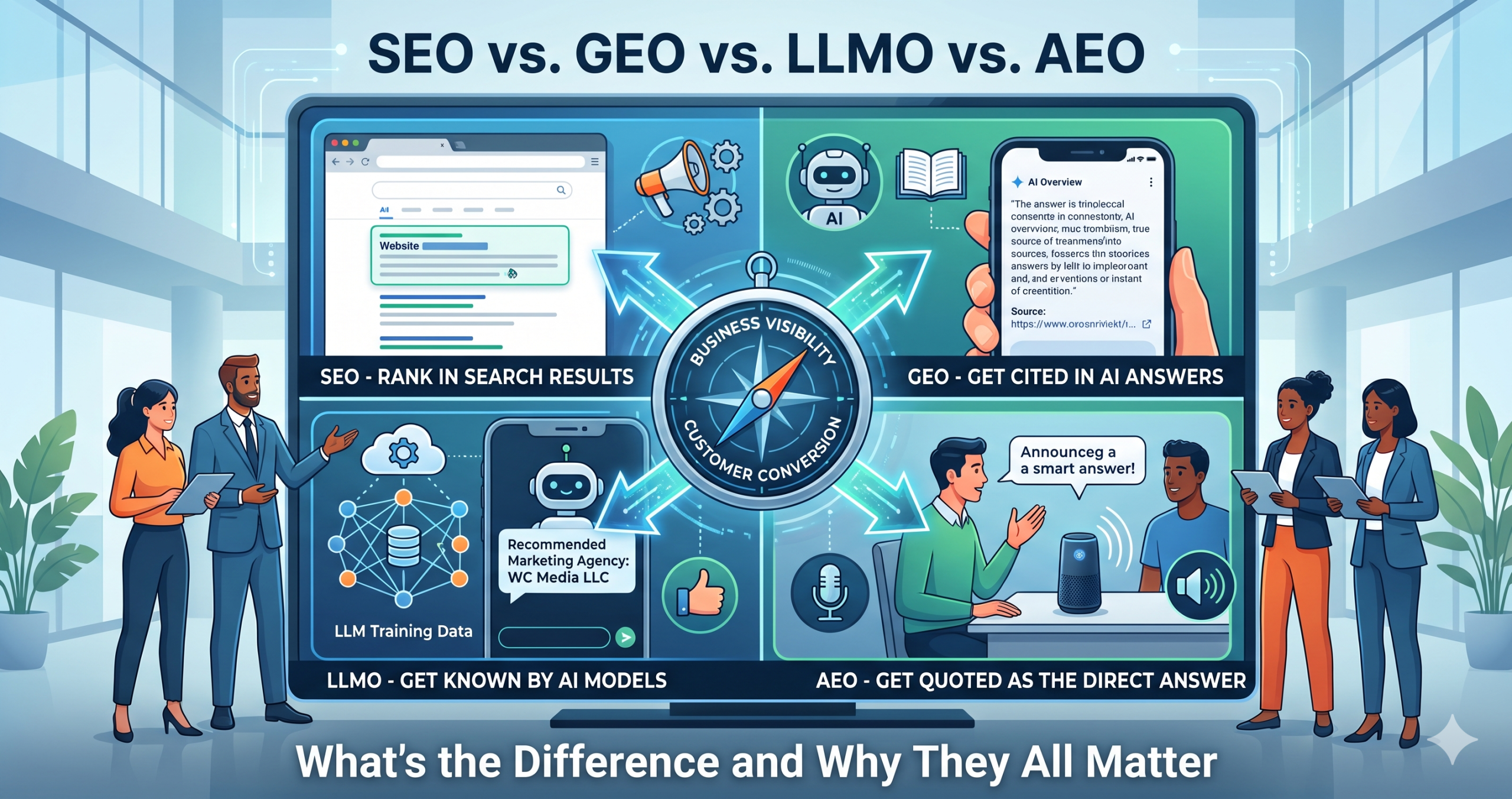
SEO — Search Engine Optimization — is the process of making a website rank higher in traditional search engine results pages (SERPs). It involves targeting the right keywords, building credible backlinks, ensuring technical site health, and publishing content that search engines judge as authoritative and helpful. The goal is to appear on page one when customers search for your product or service.
SEO isn’t dead. It’s still the foundation everything else is built on. But ranking on page one doesn’t mean what it used to when an AI-generated answer box is sitting above every result — and customers are getting their questions answered before they ever click on you.
You still need SEO. You just can’t stop there.
What Is GEO — Generative Engine Optimization?
GEO is the practice of writing and structuring your content so that AI-powered search tools — like Google AI Overviews, Perplexity, and ChatGPT with search — select your content as a source when they generate their answers.
GEO — Generative Engine Optimization — is the practice of writing and structuring content so that AI-powered search tools (such as Google AI Overviews, Perplexity, and ChatGPT with search enabled) select your content as a source when generating their answers. The goal is to be cited and quoted by AI systems, not just ranked in traditional results, by making your content easy for AI to extract and trust.
The key difference: in traditional SEO, you’re trying to rank. In GEO, you’re trying to get quoted.
A plumber in Dayton writes a blog post titled “How to Know If Your Water Heater Needs Replacing.” With GEO in mind — clear headings, a short definition of warning signs, statistics with sources cited — that post gets pulled into Google’s AI Overview when someone searches “signs my water heater is going bad.” The plumber’s business name appears in the AI answer. Their phone number is two taps away. That’s a new customer generated without a single click on a ranked result.
What Is LLMO — Large Language Model Optimization?
LLMO is about making your business recognizable and recommended by AI tools when they answer questions from their training data — not from a live search, but from what they already know.
LLMO — Large Language Model Optimization — is the process of making your business visible to AI tools like ChatGPT, Claude, Gemini, and Copilot when they answer questions from their training data rather than real-time web searches. It involves building your brand’s footprint across the web so AI models have enough credible information about you to mention, describe, and recommend you accurately.
These AI tools were trained on enormous amounts of internet content. When someone asks ChatGPT “what’s a good marketing agency for a small business in Ohio,” ChatGPT reaches into what it learned during training. If your brand barely appears in authoritative sources — if you’re absent from review platforms, industry publications, and credible directories — the AI may not know you exist.
A family-owned accounting firm earns strong Google and Yelp reviews, gets mentioned in a regional business journal, and is listed in several accounting directories. When a new resident asks Claude or Gemini for recommendations, there’s enough credible web presence that the firm gets named. Without that presence, the AI recommends whoever it has more data on — and that’s probably not you.
What Is AEO — Answer Engine Optimization?
AEO is the practice of formatting your content to directly answer specific questions, so that AI tools, voice assistants, and featured snippets can extract and display your answer word-for-word.
AEO — Answer Engine Optimization — is the practice of formatting content to directly answer specific questions so that AI tools, voice assistants, and featured snippets can extract and display that exact answer. It uses structured data (called schema markup) and conversational Q&A formats to make your content the definitive source for direct answers to questions your customers are already asking.
AEO is about winning the exact moment someone asks. When a customer says to their phone, “Hey Siri, what are the signs of a roof leak?” they’re not getting a list of websites. They’re getting one answer, read aloud. AEO is how you become that answer.
A roofing company publishes a FAQ page with a direct question — “How do I know if my roof is leaking?” — followed by a clear, 60-word answer in plain language. They mark it up with FAQ schema so search engines and AI tools can extract it cleanly. When someone asks a voice assistant that question, the roofing company’s answer gets read aloud. The business gets the call.
SEO vs. GEO vs. LLMO vs. AEO: Side-by-Side
| SEO | GEO | LLMO | AEO | |
|---|---|---|---|---|
| What it is | Ranking in traditional search results | Being cited in AI-generated answers | Being known by AI from training data | Being the exact answer AI gives |
| Where it shows up | Google, Bing results pages | AI Overviews, Perplexity, ChatGPT search | ChatGPT, Claude, Gemini (from memory) | Voice search, featured snippets, direct AI answers |
| Key goal | Get ranked | Get cited | Get known | Get quoted word-for-word |
| Primary lever | Keywords + backlinks | Clear, extractable content structure | Brand presence + third-party mentions | FAQ schema + direct-answer formatting |
| Why it matters | Still drives the bulk of web traffic | AI answers are replacing organic clicks | AI tools advise buyers before they search | Voice and zero-click searches are growing fast |
These Aren’t Four Separate Strategies. They’re One.
Most agencies treat these as four separate channels requiring four separate budgets. That’s both wrong and expensive.
Think of it like building a house. SEO is the foundation — without it, nothing else holds. GEO is the framing — it gives your content structure that AI tools can read and extract. LLMO is your reputation — the credible presence across the web that makes AI systems trust you enough to recommend you. AEO is the front door — the clean, specific answer that gets you the call, the click, the customer.
A single well-built blog post can do all four jobs at once. It targets keywords your customers search for (SEO). It has clear definitions and structured headings that AI tools can extract (GEO). It earns citations and links that build authority across the web (LLMO). And it answers specific questions in a format voice assistants and AI tools can quote directly (AEO).
That’s not four campaigns. That’s good content strategy executed with all four lenses in view.
Research from Princeton University’s 2024 GEO study (published at KDD 2024) found that content optimized with cited sources and embedded statistics earned up to 40% higher visibility in AI-generated answers — without changing the underlying topic, just the structure and authority signals.
Our Search & AI Visibility services are built around this integrated approach. One strategy. Four layers of visibility. No doubling your workload or your budget.
What Happens If You Only Do SEO?
Let’s say you have decent rankings. Good traffic. Page one for a few valuable keywords. Things are working.
Here’s the risk you may not see yet.
Google AI Overviews now appear in nearly half of all searches. When they do, click-through rates to ranked organic results drop by as much as 58%. You can sit in the number-one spot and still lose the customer to an AI summary that didn’t cite you once.
At the same time, a growing percentage of your potential customers never hit Google at all. They go straight to ChatGPT, Perplexity, or Claude and ask for a recommendation. If your business isn’t visible in those answers — because your web presence is thin, your content isn’t structured for extraction, or your brand lacks third-party credibility — you don’t exist in that moment.
SEO-only businesses are like shops that only advertised in the Yellow Pages when everyone moved to their phones. The old channel is still real. It’s just smaller every year, and it now shares the room with channels your competitors may already be building.
The businesses winning the next decade are building visibility everywhere customers are looking — ranked pages, AI answers, voice results, and direct citations. All of them, together.
Frequently Asked Questions
Do I need to hire four different agencies to handle SEO, GEO, LLMO, and AEO?
No. These are not four separate disciplines requiring four separate vendors. A good digital marketing partner should be building content and strategy that addresses all four simultaneously. If an agency only talks about traditional rankings and has nothing to say about AI visibility, that’s a significant gap worth asking about directly.
How do I know if AI tools are already showing answers to my customers?
Try it yourself right now. Search for a question your customers commonly ask about your service or industry. If you see a paragraph answer appearing above the search results with a “Generated by AI” label, that’s a Google AI Overview. Then run the same question through ChatGPT or Perplexity and notice who gets cited. If competitors are being named and your business isn’t, that’s your visibility gap.
How long does it take to see results from GEO or AEO changes?
For Google AI Overviews, content structure improvements tend to show impact in 4–12 weeks — roughly similar to traditional SEO timelines. For tools like ChatGPT when it searches the web in real time, well-structured content can appear in answers within days of being indexed. For LLMO — being known in AI training data — that’s a longer-term brand-building effort measured in months of sustained presence.
Does a small local business actually need to worry about all of this?
Yes — and local businesses may feel the impact first. AI tools are increasingly answering hyper-local queries like “best electrician in Dayton” or “who does affordable bookkeeping near me.” If your business isn’t optimized across Google Business Profile, review platforms, and well-structured local content, another local competitor fills that AI answer instead of you. Our 90-Day Local Jumpstart is built specifically to solve this problem fast.
Is my current website content already AI-ready?
For most businesses, not without some updates. Most websites were designed to rank on Google, not to be extracted by AI. AI-ready content has clear headings that mirror how people ask questions, short definition blocks for key terms, FAQ sections with direct answers, schema markup, and visible updated dates. A quick audit of your top pages will show you exactly what needs to change.
Ready to Show Up Where Your Customers Are Actually Looking?
Most of your competitors haven’t figured this out yet. That window won’t stay open forever.