What is answer engine optimization?
Answer engine optimization (AEO) is the practice of structuring and writing content so that AI-driven answer systems — like Google’s AI Overviews, ChatGPT, Perplexity, and voice assistants — can extract a direct, accurate answer and attribute it to your page. Instead of optimizing purely to rank a blue link, AEO optimizes for being the passage an AI quotes or paraphrases when it answers a user’s question. It sits alongside traditional SEO rather than replacing it.
The term has gained urgency because a growing share of searches now resolve inside an AI-generated summary before a user ever clicks a traditional result. When that happens, the “answer” itself becomes the product a brand is competing for — not just a ranking position.
How is AEO different from traditional SEO?
Traditional SEO optimizes a page to rank in a list of links a human then scans and clicks; AEO optimizes a specific passage to be lifted whole and presented as the answer, often with no click at all. Both rely on relevance, authority, and technical crawlability — but AEO adds a stricter requirement: the content has to be extractable as a standalone, self-contained statement.
In practice, that means AEO content favors direct opening statements, clear headings that mirror real questions, and evidence-backed claims — because an answer engine is choosing between competing passages, not competing pages.
| Dimension | Traditional SEO | Answer Engine Optimization (AEO) |
|---|---|---|
| Primary goal | Rank in the top results for a query | Be the passage quoted or paraphrased in an AI-generated answer |
| Unit optimized | The page as a whole | A specific paragraph or section within the page |
| Success signal | Click-through from a search results page | Citation, mention, or brand exposure with or without a click |
| Content style | Broader narrative, can build to a conclusion | Direct answer stated up front, elaborated after |
| Structure emphasis | Keyword targeting, backlinks, page speed | Question-matched headings, self-contained answers, structured data |
How does AEO relate to GEO and LLMO?
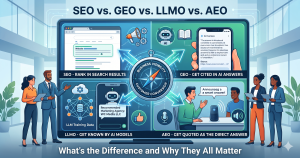
Generative Engine Optimization (GEO) and LLM Optimization (LLMO) are closely related terms that largely describe the same underlying discipline as AEO — optimizing content for AI systems rather than traditional link-based search — but they emphasize different platforms. AEO is often used for question-and-answer engines broadly, GEO is used more for generative search experiences (like AI Overviews), and LLMO is used specifically for optimizing visibility inside large language model outputs like ChatGPT or Claude.
In day-to-day practice, most teams treat the three as overlapping enough to work under a single strategy: write clear, well-sourced, directly-answering content, and it tends to perform across all three surfaces simultaneously. The distinctions matter more in marketing conversations than in the actual content work.
Why does AEO matter now?
AEO matters now because AI-generated answers are increasingly the first — and sometimes only — thing a searcher sees, which means content that isn’t structured to be extractable risks losing visibility even if it would have ranked well under classic SEO. A brand can have strong domain authority and still be passed over by an answer engine if its content buries the answer in unstructured prose.
This is a genuine shift in where the competitive battle happens: instead of competing only for position one through ten on a results page, brands are now competing to be the single sentence or paragraph an AI system chooses to surface.
What actually makes content perform well for answer engines?
Content performs well for answer engines when it opens each section with a complete, self-contained answer, backs claims with concrete specifics rather than vague generalities, and is structured so a machine can parse where one idea ends and the next begins. The core practices are:
- Direct openers: Each heading should be followed immediately by a paragraph that fully answers the question implied by that heading — before any elaboration.
- Evidence and specificity: Named sources, real figures, and dates are what separate a citable passage from a generic one. AI systems are more likely to quote content that anchors claims in verifiable detail.
- Clean structure: Headings phrased as real questions, tables for comparisons, and lists for discrete items all make content easier to extract cleanly.
- Genuine depth: Covering the sub-questions a reader actually has — not padding for length — signals to both readers and crawlers that a page is a complete resource, not a thin summary.
Notably, keyword repetition and content designed purely to hit a word count work against AEO performance rather than for it — the same over-optimization patterns that hurt classic SEO hurt AI visibility even more directly.
How can a brand measure AEO success?
AEO success is measured less by rank position and more by presence: whether a brand’s name, data, or phrasing shows up inside AI-generated answers, chatbot responses, or voice assistant replies, regardless of whether that generates a click. Because most AI platforms don’t yet expose citation-level analytics the way Google Search Console exposes keyword rankings, measurement today is a mix of manual spot-checks (asking the target questions directly to ChatGPT, Perplexity, and Google’s AI Overview) and monitoring referral traffic patterns for AI platform sources in analytics.
This is an evolving measurement space — tooling that reliably tracks AEO citations at scale is still maturing across the industry, and any brand claiming precise, automated AEO analytics today should be evaluated with that caveat in mind.
Frequently asked questions
Is AEO the same thing as SEO?
No. AEO builds on the same technical and authority foundations as SEO but adds a specific requirement: content must be structured so an AI system can extract a standalone answer, not just rank in a results list.
Do I need to choose between SEO, GEO, and AEO?
No — the practices largely overlap. Content written with clear, direct, evidence-backed answers tends to perform well across traditional search, AI Overviews, and chatbot answers at once.
Does AEO mean fewer website clicks?
It can, since an AI-generated answer may fully satisfy a user without a click-through. The tradeoff is potential brand exposure and citation even without traffic, which is why AEO success is measured differently than traditional SEO traffic.
What’s the first step to optimizing existing content for AEO?
Rewrite the opening of each section so it fully answers the heading’s implied question in the first few sentences, then add concrete data or named sources to back up the claims that follow.